By Phoebe Farris (Powhatan-Pamunkey)
Dr. Selene Phillips (Lac du Flambeau Ojibwe) works as an Assistant Professor of Communications at the University of Louisville, Kentucky. A gifted poet and storyteller whose creative writing reaches into the heart and soul of her beloved Ojibwe community, she is recognized nationally in the fields of journalism, communication, Native American studies, and Chautauqua performance. Chautauquan performers are known for diverse, high-quality entertainment, including traditional acts like ventriloquism and modern spectacles, bringing art and culture to audiences. Phoebe Farris spoke with Phillips about this work.
Phoebe Farris: What is Chautauqua performance?
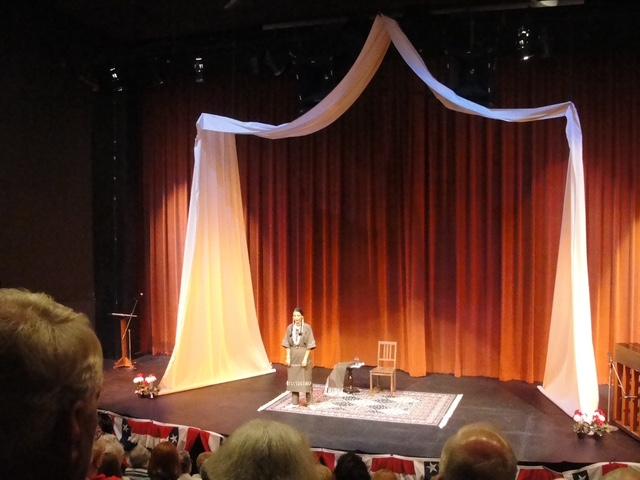
Selene Phillips: The original Chautauqua refers to the days after the [mid-19th century] lyceum movement, which improved American literacy. Before telephones, radio, movies, television, and cars, tent-packing caravans of orators, politicians, and revivals toured rural America for democracy and education. The modern-day Chautauqua is a scholarly performance of a historic figure who made a significant contribution to American society. Most Chautauquans have at least a master’s degree and are dedicated to education.
The Chautauqua Institution in New York explores educational programs for religious, social, and political issues, including creativity and appreciation of the arts, performance, and teaching to inform and engage the public. Sometimes the word Chautauqua is used to evoke a carnival or variety show imagery. But for Chautauquans, a Chautauqua refers to a scholar who embodies a historical figure, performs and answers questions from an audience, then re-engages with the audience as the scholar.
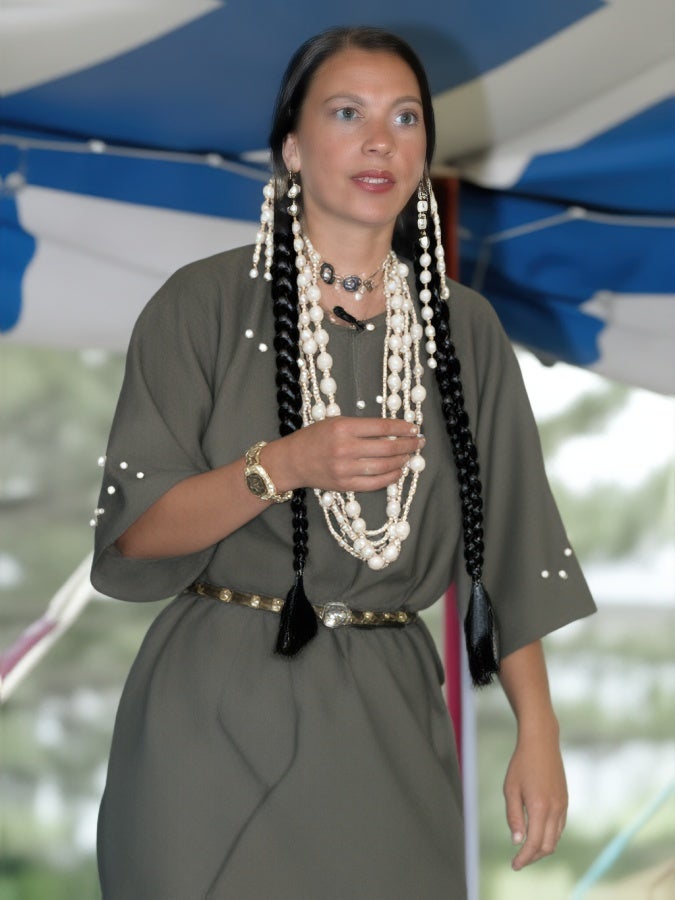
Selene Phillips as Sacagawea.
PF: Most of the women that you have portrayed on your Chautauqua tours, such as Sacagawea, Eula Pearl Carter Scott, and Zitkála-Šá, were Native American. As a Native woman living in the 21st century, how do you prepare for roles that span decades and centuries? Was it more challenging to portray a European-American like Mary Todd Lincoln?
SP: Each character presents a new challenge, and they are difficult in different ways. Sacagawea was difficult because she was never directly quoted. She never wrote a word. She is misunderstood and misidentified as a Lewis and Clark guide. She was so much more and primarily included in the voyage as an interpreter. I had to work against a persistent trope of a romance between Sacagawea and Captain Clark, to which there is no evidence. The voyage was a military excursion. Sacagawea was used during the suffragette movement to embody change and courage. Imagery of a woman escorting men through a wilderness territory clashes with what Indigenous people know—no vast empty wilderness waited to be tamed. According to their own writings, Lewis and Clark met new Tribal Nations almost daily.
During a recent workshop, I crushed two women’s ideas that Sacagawea embodies multiculturalism, individualism, and rights to western expansion, and that she loved Clark, instead of her French foreign provider [who was] the father of her child. Her Indigenous values of community, family, and environmental harmony juxtapose sharply against capitalism, individualism, and accepted practices exhausting natural resources. Most authors of the Sacagawea children’s books erroneously emphasize a relationship with Clark and portray her as a woman who would have done anything for Lewis and Clark, [leaving] her world for an American life. Despite evidence based on the diaries of Lewis and Clark, the two women did not want to believe me.
Preparing for a character like Sacagawea required me to extend studies beyond the Lewis and Clark diaries and scholars who wrote on them, like Gary Moulton and Dale Nelson. I spoke with linguists and Tribal people who spoke and studied Shoshoni, Hidatsa, Mandan, and French languages and culture. I read all of the children’s literature on Sacagawea to know what the public thought was her life. I inserted Tribal values into the mix. That set my Sacagawea on edge or on her head. It was a tremendous amount of work, but it was incredibly engaging and fun.
Debunking myths was often the theme of my Mary Todd Lincoln creation. Some Abraham Lincoln admirers find it hard to believe the two were a good match. The more I studied their writings, their closeness, and their mutual love of poetry, the more I understood what a divine match they were. One time, Lincoln said to Mary in reference to her gown, “Our cat has a long tail tonight. If some of that tail was nearer the head, it would be in better style.” This demonstrated their ability to tease and challenge each other. They complimented each other.
PF: How do you channel your characters’ personalities?
SP: For the most part, when I become a character, I study as much about them, the time period, and the associated topics as possible. I outline which stories I want to tell and construct the performance with what is appropriate for the character, the time frame, and what my audience should learn. Then, I live with those thoughts, facts, and imagery for a time. Sometimes I’m fortunate to talk to those who knew her. I’ll ask how she would think and respond. Without any surviving friends or relatives, I have to draw upon other information.
I admire all of the characters I’ve performed. Eula Pearl Carter Scott was a gem. I spoke to her grandson. At one time, she was America’s youngest pilot. She has encouraged me to continue to try new things and push to the unknown. I saw snippets of her on video. I went to the Experimental Aircraft Association museum in Oshkosh, WI to sit in a plane like the Curtiss Robin she flew. I called my brother, Todd Phillips, asking about aircrafts and flying. During a performance, a man stood during the Q&A. He said, “I knew Eula Pearl Carter Scott. She was a neighbor.” I gulped and thought, “Have I offended anyone or made a mistake?” He continued, “I want you to know that as I sat here, there were times I forgot you weren’t Pearl. I felt like you were her.” I soaked in the moment. I may never receive a Chautauqua compliment like that again.
Zitkála-Šá, or Gertrude Simmons Bonnin, is a stark contrast to historic figures who left few documents. Brigham Young University’s archives have boxes of Zitkála-Šá’s papers. I only planned on staying in Provo a few days, but my husband, Mike Chappell, and I stayed a week, and I need to return. We arrived early in the morning and stayed until words danced in front of our tired eyes.
PF: When I saw you on your first tour as Sacagawea, I was amazed at your ability to speak English, French, and the two Indigenous languages that Sacagawea spoke, Shoshone and Hidatsa. Did your understanding of your own Ojibwe language help in speaking other Indigenous languages?
SP: It required a lot of work and the generosity of Indigenous language speakers. People connected me with those who spoke or taught Indigenous languages. Many generously worked with me. Some pronunciation took work. I do not do the Hidatsa or Shoshone language justice; I want to learn more. I’ve taken French since high school. This summer, I made it to Paris. It was fun speaking French to the Parisians at Notre Dame. Knowing more than one language or learning an additional language usually makes learning an additional language easier.
PF: Sacagawea is well known to many Americans because of her historical participation in the Lewis and Clark expedition, but Zitkála-Šá (Lakota), a writer, musician, activist, and former President of the National Council of American Indians, is less well known. What are some of her achievements and importance to American history?
SP: At 8, Zitkála-Šá was taken from her Yankton home to an Indian boarding school. She won an oratorical contest while at Earlham College and was ridiculed at the state competition. She taught at Carlisle for a while. Her formal relationship with the Indian movement began in 1921. At her request, the General Federation of Women’s Clubs took up Indian welfare, supporting her national public lectures. She contributed to the work achieving American citizenship and the right to vote for Indians, which occurred in 1924.
In 1923 and 1924, long before David Grann wrote the book, “Killers of the Flower Moon”, which became a movie, Zitkála-Šá had collaborated with Matthew Sniffen, secretary of the Indian Rights Association, and Charles Fabens, a lawyer working with the American Indian Defense Association, on what became “Oklahoma’s Poor Rich Indians.” The report revealed injustices done to the Osage and the Five Civilized Tribes. Corrupt judges, guardians, attorneys, bankers, and merchants conspired to have Indians declared incompetent to take their money and estates.
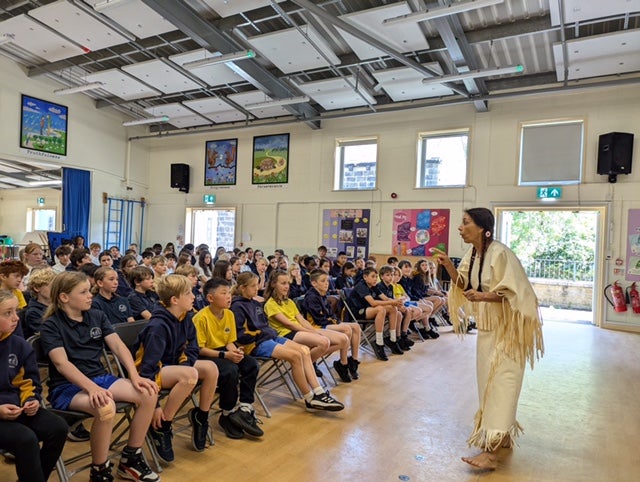
Selene Phillips as Zitkála-Šá.
After 1926, she lectured less and challenged Congress and the Indian Bureau. As the President of the National Council of the American Indians, she worked to end poverty and starvation and for equality. She helped co-write “The Sun Dance Opera”, the first opera with a Native American theme and players. Initially, she was not given credit for her significant participation. Zitkála-Šá is more known than Pearl, but less known than Sacagawea or Mary Todd. But, I don’t have to interrupt as many stereotypes with Zitkála-Šá as with Sacagawea or Mary Todd. In a way, I may start from scratch. Zitkála-Šá was a hardworking, strong willed, dedicated, and complex Yankton woman.
There’s always more research to conduct. Always. I will never be done learning about any of my characters, their world, their historical time, and how life might have been for them.
PF: How do you balance the responsibilities of teaching and research as a professor and theatrical performances/touring?
SP: I don’t. I often feel like a failure. My university does not value what I do, because my performances are not written publications. I look at the bigger picture. Last spring, I portrayed Zitkála-Šá at home on my Lac du Flambeau reservation and played the violin. My cousin, Ann Hartzheim, teaches first grade, and the students wrote me incredible thank you notes. One little guy toted a harmonica to school the next day and said he could play an instrument, too. She sent me a video of him playing.
Last fall, I performed in Lower Brule, where some of Zitkála-Šá’s relatives live. I hope I never forget the impact I made on those beautiful grade schoolers. I performed for the St. Joseph’s Indian School in South Dakota. As I prepared to play, I asked if anyone played the violin. Some students raised their hands, but their teachers smiled and winked a “no.” After my piece, the children clapped so hard and long, I almost cried. I just started playing the violin after I turned 60. Most violinists start around age 4. I pray I’ve influenced them to appreciate reading, history, and music, and to pursue their own adventures.
I am thankful for a supportive husband, family, and department. Although I perform and educate hundreds and sometimes thousands, my school does not support these endeavors via a promotion or financially. We used to receive a travel stipend for research. I am thankful to Humanities programs and the Oklahoma Chautauqua, which supports scholarly research. I pay for most of the travel. For Zitkála-Šá, I have traveled to Provo and Salt Lake City, several reservations, including Yankton and Lower Brule, and Wabash and Richmond, Indiana. I need to travel to Madison, Wisconsin, Arizona, Arlington, Virginia, and the BIA archives to learn more. Gas and hotels are expensive. There are few resources or grants to pull from that support those ventures.
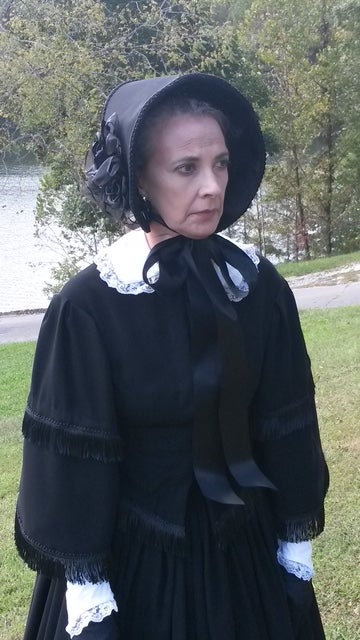
Selene Phillips as Mary Todd Lincoln.
PF: Your roles also require knowledge of the clothing worn by women in different time periods, and of different Tribal backgrounds, as well as “races.” Is there an historical fashion consultant or designer employed by the organization that produces Chatauqua performances? What is your involvement, especially concerning Indigenous beadwork and hairstyles?
SP: I design and make the clothes. I read and look at material, magazines, and pictures from the time periods. The process of making and designing my own dresses helps teach me more about the time period and my characters.
For Sacagawea, there were no photographs. I studied George Catlin’s and Karl Bodmer’s drawings and paintings. My little niece and nephew picked out shells as I created my own design from within the realm of possibilities based on research. The curators and museum directors at all of the Tribal Nations have been incredibly helpful and generous with their time. They connect me with individuals who share useful information. I just visited Woolaroc in Oklahoma, where I studied the clothes and the jewelry.
Working on the clothing helped me develop characters. Mary Todd’s dress was a lesson in fashion history and showed me how detailed clothes were in her time. My mother, Paulene Phillips, and her friend, Charlotte Newgent, in Lafayette, Indiana, were generous with their skills and helped with Mary Todd’s dress and hat.
My lightweight designs are versatile, easy to pack and roll up, and allow me to move. For Mary Todd’s hooped skirt, that was a tall order. Using real leather is ill-advised. One summer, breeze-less Oklahoma night under a tent, I performed Sacagawea in 111-degree heat. Zitkála-Šá was continuously asked to wear her buckskin. Her husband assisted her, because, as she aged, the dress’s heft became a difficult chore.
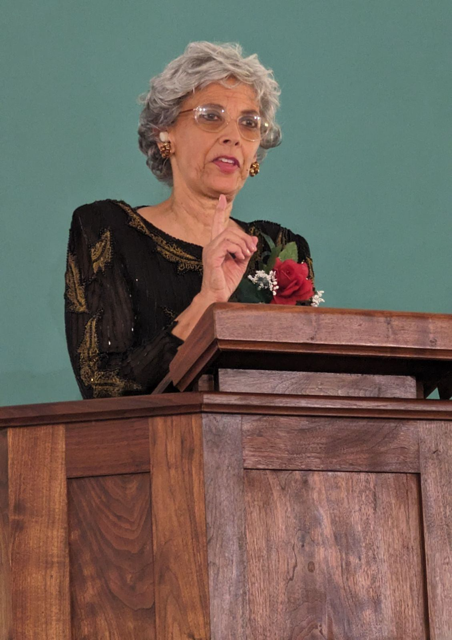
Selene Phillips as Eula Pearl Carter Scott.
PF: Eula Pearl Carter Scott (Chickasaw), a stunt pilot and an inductee in the Oklahoma Aviation and Space Hall of Fame, is your most contemporary character. At first I thought that would make her less challenging to portray, but your acting was so impressive. Do you have any formal acting training?
SP: I have no formal training. However, I have incredible parents who encouraged my performing endeavors. Most parents discourage their children from a career in the performing arts for fear they would not be profitable.
Sometimes it’s a little thing that moves an actor into a role. For Pearl, a friend loaned me her mother’s wig. I become Pearl with that wig. I age. My head and body movements change. My mindset goes to age 80. Keep in mind I’ve also lived with my characters, her material, her documents, her geographic space, and her time frame, for months, sometimes even years. The switch is easier when you’ve been doing it in your head for so long.
PF: You have traveled across Turtle Island performing indoors and outdoors, on reservations, and in England. How does it feel to perform for young children?
SP: Performing for various age groups reminds me where young people’s minds are. [At a performance for first graders] when I said, “my husband,” referring to Zitkála-Šá’s husband Raymond Talefase Bonnin, the children kept turning around to look at my husband, Mike Chappell, in the back of the room. It’s sad, but social media has diminished the ability to play ‘let’s pretend.’ I envision an educational system where Chautauquas become a regular part of studying history. Children could pretend to be someone else, a historic figure or an ancestor. They could interview their grandparents and dress up. There is great potential here, especially for Indigenous communities where our history is often trivialized.
Captain Lewis was shot in the butt by one of his men, but that fact was covered up for years because it was not acceptable news for children. But it is more exciting for children to know history’s quirky, dumb, and fun facts. I traveled with Chautauquan Jeff Smith, who portrayed Captain Clark. In a children’s workshop, Jeff would talk about the expedition’s “gross” things as well as the incredible amount of meat consumed for the voyage’s physical exertion. He made it memorable. Children loved it. History needs to be something we embrace instead of engaging in a culture war. For Indigenous communities, it has always been something that we have had to fight for. Our stories are significant, historic, relevant, and revealing. Burying them won’t make them go away.
I performed Zitkála-Šá for fifth and sixth graders in Leeds, England. English students are required to study Native American history. They were smart and engaged and did not have cell phones. We had to cut the Q&A portion off after over 30 minutes so I could catch my train. Compare that to an American high school where I performed where students did not ask one question. For the most part, American students are not required to study Native Americans. This is unfortunate, because Native Americans are the fabric of what this nation is and wants to be— or what it used to want to be.
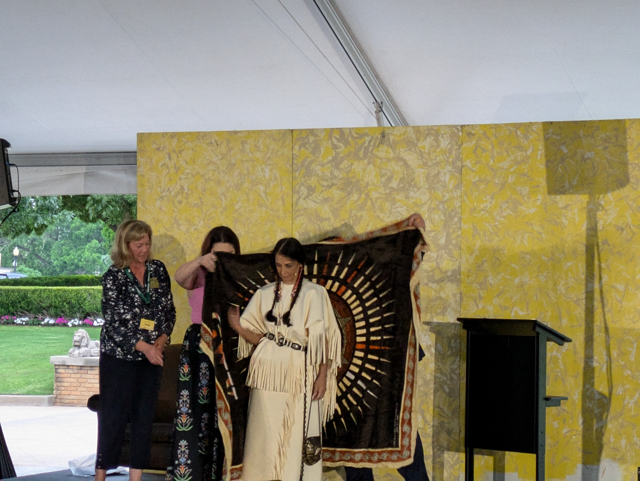
PF: Last June you were honored in Tulsa, Oklahoma as shown in this Blanket Ceremony image above. How did you feel about your achievements being acknowledged?
SP: When I performed Zitkála-Šá in Tulsa, I was pleasantly surprised to see a number of Native Americans in the audience. Usually there’s only one or two. After I performed Zitkála-Šá and after the Q&A ended, I was asked to stay on stage. That was unusual. Then the regional vice president of the National Council of American Indians and Cherokee Nation Tribal council member, Joe Deere, and Oklahoma State Representative Amanda Clinton (Cherokee), who was then running for office, came to the stage. I thought we were going to have an additional Q&A. They shocked me by honoring me with a Blanket Ceremony for my research and work portraying and promoting Zitkála-Šá’s life. Also in attendance were former Cherokee Chief Ross Swimmer and other dignitaries. I was in tears. How often is a scholar recognized for work where she immerses herself into mundane facts of a dead person’s life and brings that character to life?
I felt the presence of my dad, Byron Phillips, and my friend and fellow Chautauquan, Charles Pace. Both recently passed away. It wouldn’t be possible without them. Dad thought I could do the impossible. And Charles asked me to portray my first Chautauqua character, Sacagawea. Charles was the best Chautauquan and looked like Frederick Douglas. He portrayed York, Booker T. Washington, W.E.B. Du Bois, Lanston Hughes, and Malcolm X. I am blessed to be an Ojibwe woman portraying Indigenous women ranging from a 15-year-old Shoshoni girl to an 80-year-old Chickasaw woman.
--Phoebe Farris (Powhatan-Pamunkey descent) is Contributing Arts Editor for the Cultural Survival Quarterly magazine. An art critic, curator, author, and photographer, she has written extensively on Indigenous visual, literary, and performing arts for over two decades. Farris is also a Professor Emerita of Art and Design at Purdue University and has curated and contributed to exhibitions highlighting Native and global Indigenous artists. Her work bridges scholarship, creative practice, and advocacy, amplifying Indigenous voices in contemporary art and media.