
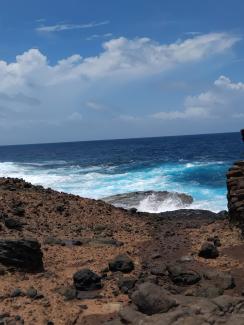
In a remote, yet treasured, region of Dominica’s Atlantic Coast lies the Kalinago Territory. It is the last remaining Indigenous territory in the Caribbean, vital to the safeguarding of the Kalinago Peoples’ cultural heritage. As evident in the island’s nickname, the “Nature Island of the Caribbean,” the mountains, forests, and ocean that encircle the Atlantic coastline form far more than a landscape; they are part of a living heritage, filled with the stories, practices, and resilience of the Kalinago Peoples.
It is here that Tana Valmond, a young Indigenous artist and environmental advocate, was born—to a place where culture and environment are tightly interwoven, and where the first lessons come not from textbooks, but from the land and sea themselves. Through her art, community engagement, and work with Bow Seat: Creative Action for Conservation, Valmond is helping to reshape the conversation around climate change, youth activism, and Indigenous leadership. Her story begins in a place most people have never heard of, with the quiet, but powerful, decision to speak up.
A Territory that Teaches
The Kalinago Territory is home to around 3,000 people. It spans 3,700 acres of communal land granted to the Kalinago Peoples by the British colonial government in 1903, following centuries of displacement and resistance. Despite its small size, the territory holds immense cultural and historical significance. Here, rivers and cliffs hold memory, and respect for nature is not just a value, but a way of being. Valmond grew up immersed in these teachings. “We were told stories about how the land and sea were formed by ancestral spirits. Our oral traditions are full of reminders that our role is to live in balance with nature, not dominate it,” she says. Nature is not separate from the Kalinago identity, nor is it thought of as a mere tool for one’s gain: it is integrated into spiritual practices, daily rituals, and community decision-making. Fishing, farming, and hunting are more than a means of survival—they are forms of relationship. The ocean, in particular, is seen as both protector and provider. It feeds, it warns, it nurtures. “The ocean to us isn’t just water,” Valmond says. “We created a bond that’s both emotional and spiritual. We don’t see nature as separate from us, but us just being a part of it as one entity.”
But even in a place as storied and resilient as the Kalinago Territory, change has come. Valmond began noticing coral reefs bleaching, rivers drying up, and coastlines eroding. The staggering loss of biodiversity on land and at sea hit especially hard on an island so cherished for its wildlife and bountiful provisions. These were not seasonal shifts; they were signs of climate disruption. Her Elders confirmed what she suspected: these changes were new, and they were accelerating. The urgency to respond became personal. She realized that the places she loved were under threat, and she couldn’t stay silent.
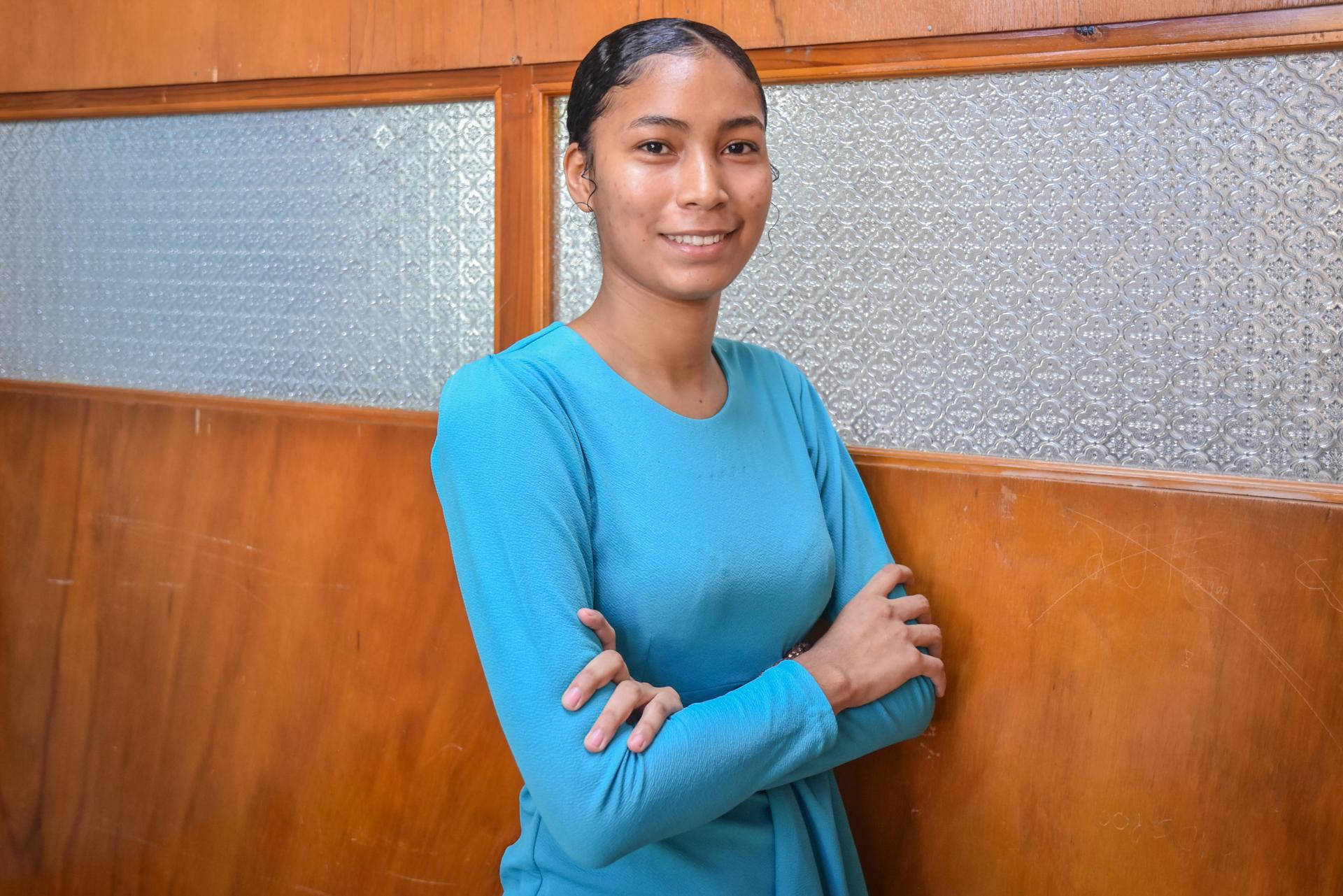
Tana Valmond.
Finding Her Voice
With climate awareness often comes a sense of dread, or the paralyzing feeling of hopelessness in the face of a monumental issue. For Valmond, the lifelong love she felt for her home transformed into a sense of obligation and a desire for action. She turned to art as a way to process what she was seeing, capturing the disappearing beauty of her home and the grief that came with it. But she also embedded her work with hope and reverence. Art became her way of bridging the past and future, of expressing both vulnerability and strength.
Valmond’s artistic journey took a pivotal turn when she discovered Bow Seat: Creative Action for Conservation, a U.S.-based, globally-reaching nonprofit that empowers youth to use art and storytelling for ocean conservation. As she created artwork for Bow Seat’s Ocean Awareness Contest, she learned to incorporate traditional stories, environmental themes, and personal experience into her work and felt encouraged to embrace all parts of her identity. “[The contest] was one of the first platforms where I saw that my voice and my art could get a chance to reach people globally. It made me realize my voice matters,” Valmond says.
Soon after, Valmond joined the Future Blue Youth Council, Bow Seat’s international youth leadership group. The Council brings together young ocean advocates from around the world to collaborate on creative environmental initiatives. Council members also mentor Bow Seat’s True Blue Fellows, young people who receive funding to lead projects addressing oceans, waterways, or climate through a creative arts lens. Valmond thrived in the collaborative, youth-led environment. She mentored younger participants, helped design outreach projects, and developed educational content rooted in her culture. She didn’t just want to raise awareness—she wanted to build connection.
Even now, as a Youth Council alumna, Valmond works as an active member of the Bow Seat team, where she serves as an Alumni Advisor, motivating youth to enter global conversations about climate action and social justice. As she recounts her experience working with other youth from across the globe, “We came from different backgrounds, but shared the same love for the planet.”
Counted Out
Despite her growing recognition, Valmond quickly learned that environmental spaces are frequently unwelcoming to Indigenous perspectives. She has often found herself having to explain or defend the validity of Traditional Knowledge. “There’s this assumption that if something isn’t written down, it isn’t real,” she says. “But our people have lived sustainably for centuries. Science is only now catching up to what we’ve always known.”
At times, Valmond’s identity as a Kalinago youth is celebrated superficially, while her insights and lived experience are viewed as side notes; her contributions treated as symbolic rather than strategic. “I’ve been in rooms where my input was overlooked. Our Traditional Knowledge was seen as less scientific, so therefore that just makes it invalid,” she says.
Navigating these dynamics has been emotionally taxing. Valmond admits to moments of self-doubt and burnout, especially when she feels pressure to represent an entire community while still learning and growing herself. “I’m young. I haven’t lived through everything. But I keep showing up because our story is still being written,” she says. What sustains her is her connection to the land. When things get overwhelming, she returns to the rivers and forests of Dominica. There, she finds not only calm, but clarity.
A Future Led by Culture and Courage
Valmond’s vision for the future is bold, rooted in tradition. She dreams of a thriving Kalinago territory with a flourishing ocean and restored biodiversity, and she hopes that Indigenous communities can lead climate solutions, not merely be consulted on them. She wants Traditional Knowledge to be respected alongside academic science. She hopes that people can live in balance with nature, thanking it for what it gives to them, because so much goes unsaid. And she wants young people—especially those from marginalized communities—to know that they don’t have to change who they are to make a difference.
Valmond’s motivation comes from the people around her: her Elders who passed down wisdom, her peers who stand with her in solidarity, and the younger Kalinago children who view her as a role model. “If they see me take action, maybe they’ll feel like they can, too,” she says. “That’s what keeps me going.”
Valmond isn’t just telling her story—she’s building a bridge between generations, between cultures, and between art and action. In her, we see a future where climate leadership is creative, community-driven, and deeply rooted. Environmental advocacy goes beyond saving nature. It’s about honoring identity, history, and the living knowledge of those who have always protected the Earth. “I want a future where culture, climate, and community go hand in hand,” she says.
In a world that often separates science from spirit, activism from art, and culture from conservation, Valmond stands at the intersection—and she’s just getting started. “We are here, we are alive, and our voices matter. When we uplift Indigenous voices, we’re not just preserving tradition: we’re protecting the future, we’re building for the future.”
Jing Graber is a Bow Seat alumna. Bow Seat: Creative Action for Conservation provides an innovative space for teens to connect, create, and communicate for our blue planet. Working at the intersection of ocean science and arts education, their award-winning programming emphasizes creative thinking and making in exploring the natural world.
All photos by Tana Valmond.