
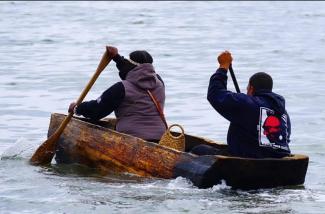
The waterways of Long Island and the neighboring estuaries have always carried more than water; they carry story, ceremony, and kinship. For the Indigenous Peoples of this island—Shinnecock, Unkechaug, Matinecock, Setalcott, Montaukett, and our relatives—the mishoon (dugout canoe) has long been a vessel of connection. It bridges not only waters, but generations, teachings, and the living memory of our ancestors.
When we bring the mishoon back into use today, we are not simply reviving an old tradition. We are mending relationships that colonization tried to break with the land, the water, and one another. Each burn, each paddle, each shared teaching is an act of remembrance and resistance. The work being done today by cultural stewards on Long Island is not performative; it is deeply lived. It is about carrying our ancestors’ voices forward in the only way that truly honors them—by practicing what they fought to preserve.
Too often, we see canoes sealed behind glass cases, labeled as relics of a Peoples who no longer exist. But for coastal Native Nations, the mishoon is alive, and so are we. It is meant to move—to feel the pull of the tide, to hold ceremonies, to teach young hands how to listen to the fire and water. When we speak of rekindling kinship routes, we are talking about restoring an entire system of relationships. Those teachings live in our oral traditions, passed from teacher to student through story, song, and time spent together in the work. In the burn of a canoe, in the rhythm of paddling, in the songs that rise from the water, we remember how to be in right relationship. Our waterways were once our highways connecting us to our sister Tribes, carrying our languages and laws, our stories and songs. To bring back the mishoon is to reopen those pathways, both physical and spiritual.
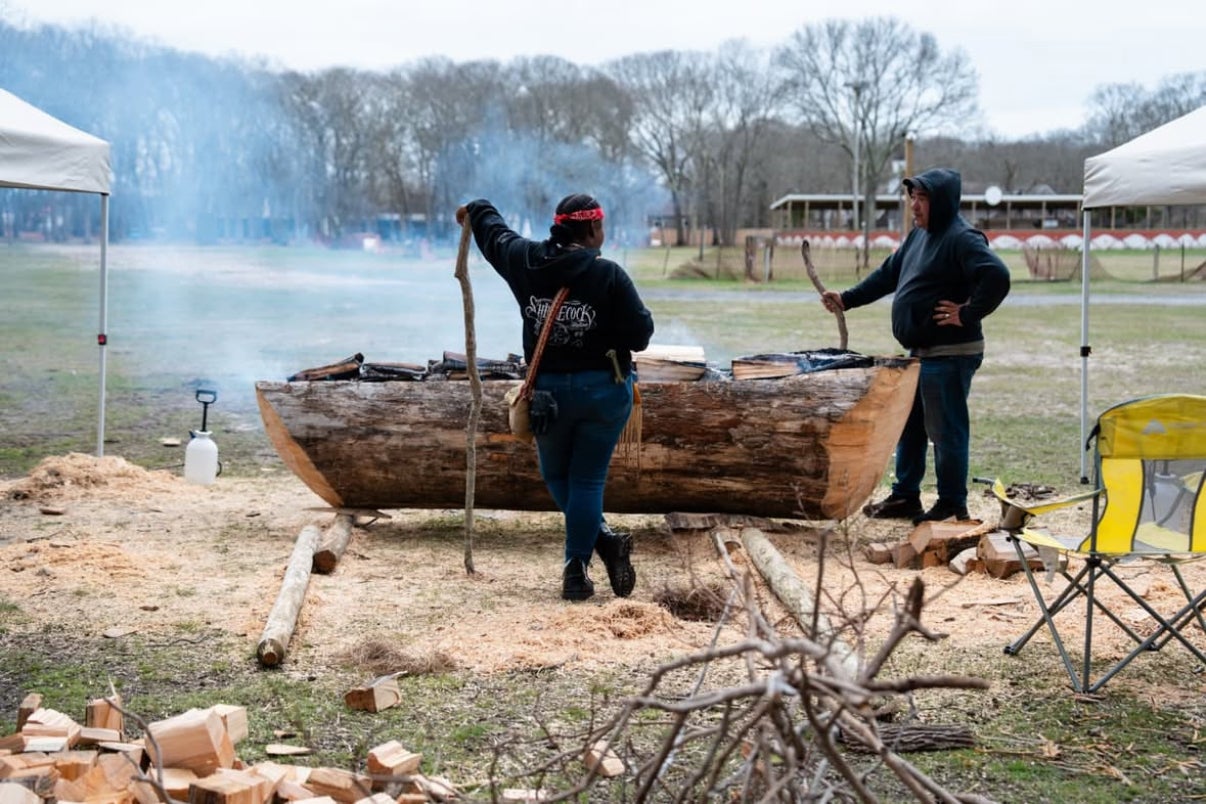
Chenae Bullock and Darius working on Peweas Koowa (“Little Pine”). Photo by Rebekah Wise.
Shinnecock’s Return to the Mishoon
In April 2025, I was commissioned by the Long Island Children’s Museum to build a mishoon for their Salt Water Exhibit. For me, this was more than a project: it was a continuation of our ancestors’ struggle to keep our culture alive. On Shinnecock land in the Shinnecock Pow Wow Grounds, we built a Mishoon camp and invited community members to participate and experience a full week of an immersive experience of traditional living. We burned and shaped Peweas Koowa (“Little Pine”), working alongside my mentor, Darius Coombs (Mashpee Wampanoag), and Shane Weeks (Shinnecock).
The white pine that Coombs harvested in Massachusetts became a vessel of connection, a living example of cross-Tribal support that sustains our ability to continue this work on Long Island, where overdevelopment has made such trees scarce. When Peweas Koowa was displayed at the museum, it did not stand as a relic of the past, but as proof of our continued presence. Native and non-Native children alike will see that our ways are not gone; they are living, breathing, and returning.
During the build, children from the Shinnecock Boys & Girls Club joined us. They helped sweep the ash, offered tobacco, and listened to the stories carried by the canoe. That is how oral teachings live—not through words, but through shared experience.
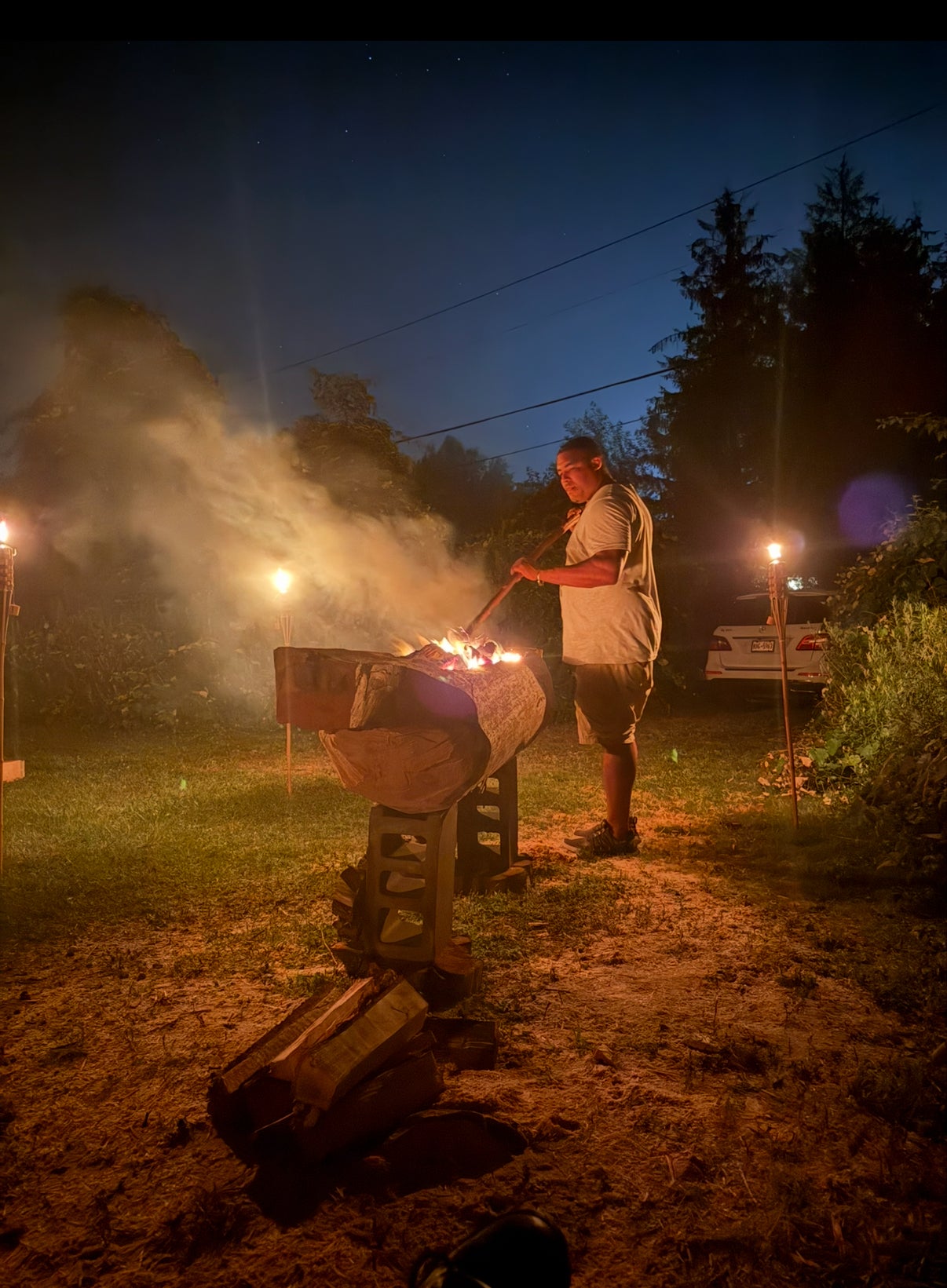
Shane Weeks working on the mini Mishoon burn.
Apprenticeship, Mentorship, and the Power of Oral Teachings
Very often, people see the student’s work without ever knowing the teacher’s name. But in our traditions, it is the teachers, the knowledge keepers, the storytellers, the ones who fought to pass down what was nearly taken, who hold our survival. Coombs has built over 50 mishoons in his lifetime. He is one of the few remaining young Elders who carries the oral teachings of this craft—not just how to burn and carve, but how to speak to the tree, how to ask the land for permission, how to carry that respect into the water. I was honored to learn under him at what is now Plimoth Patuxet Museum, when he was the Director of the Wampanoag Homesite. I was one of the only women to be stationed in the “men’s domain,” where mishoon-building took place. Coombs saw in me not just skill, but a lifelong relationship to the water built through my experience in canoe journeys across the Northeast, the Pacific, and Canada. His belief in me reaffirmed what our oral teachings always say: knowledge is meant to flow, not to be kept. These relationships between mentor and apprentice remind us that every canoe is also a story, a classroom, and a prayer.
Weeks, a craftsman, artist, and community steward of the Shinnecock Nation, has played a key role as apprentice, advocate, and cultural bridge. He participated in the Peweas Koowa burn as an apprentice canoe builder, but his contributions extend far beyond the canoe. He hosts cultural education sessions in schools, community events, and gatherings across Long Island. He also founded Ohke Creations, making soy wax candles infused with scents of sacred plants and fire that bridge traditional sensory experience with contemporary craft. His presence on local committees helps link the Shinnecocks’ cultural resurgence with municipal and regional frameworks.
Through mentorship and public work, Weeks embodies the path of apprenticeship, carrying teachings forward from those who came before into the present generation. In October 2025, he debuted his project at the Queens Museum called “Of the Earth: Connections.” In this project, he exhibited a mini-mishoon that we worked on together. Over time, these small vessels can lead to larger ones. They can lead to coast-to-coast journeys, seasonal paddles, and a restored Northeast canoe society—one that remembers that we were never landlocked in spirit, but always water people.
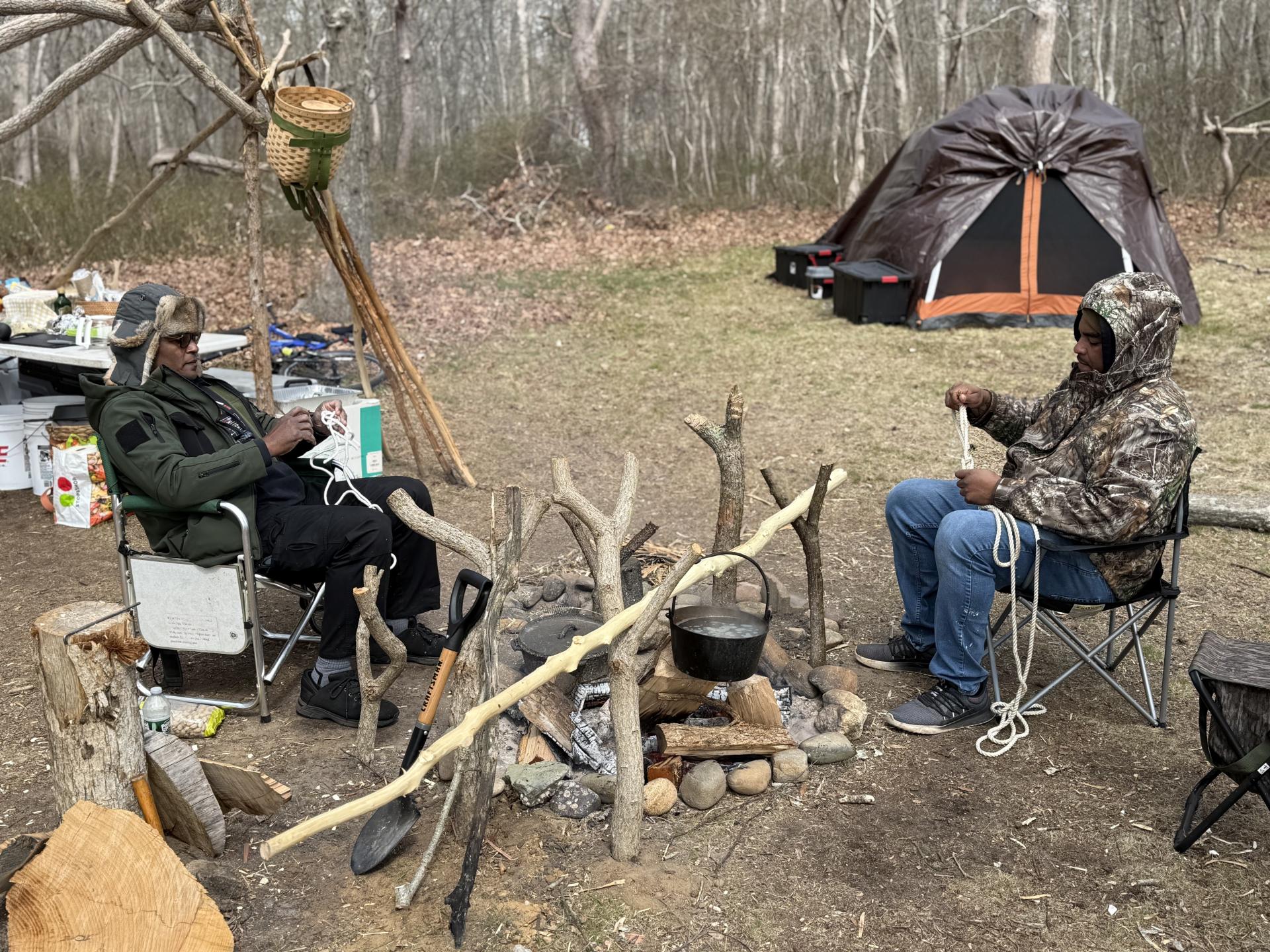
Reginald Bullock passing down knowledge of knot-making to Shane Weeks in the mishoon camp.
More Than Symbolism: Restoring Scarce Oral Teachers
In many of our communities, the teachers of oral tradition are becoming few. Colonization tried to silence our voices, but each mishoon burn reignites them. Every time a youth sweeps the ashes or hears a story beside the fire, the teachings live on. We owe our gratitude to those who kept speaking when it was dangerous to do so. They did not just pass on knowledge; they protected our way of being in the world. Their strength gives us the chance to teach again.
The canoe is not just a cultural symbol: it is deeply ecological and political. As stewards, canoe-builders hold authority in selecting trees with protocol, caring for waterways with ceremony, and maintaining relationships with land and water that colonization severed. To paddle is to assert presence on waters from which Indigenous people were restricted or excluded. As water crises, pipeline struggles, and rights disputes intensify, so does the urgency of mishoon return. Canoe journeys become water ceremonies, connections between people and ecosystems renewed.
Reviving a living canoe culture is not without obstacles. Access to appropriate trees (especially large old-growth pines), legal and land constraints, resource funding, and sustaining intergenerational mentorship are all real struggles. In many places, even finding Elders who hold full technical or ceremonial knowledge is rare. Yet, what we see in Long Island is promising: small builds like Pewea Koowa that respect scale and feasibility, collaboration across Tribes, youth inclusion, public outreach, and alliances with museums, funders, and stewards of land.
Rekindling kinship routes through mishoon culture on Long Island is a path of resilience, remembrance, and relational renewal. Under the care of teachers who are not just reviving canoes, we are reviving a relational architecture between people, water, land, ancestors, and future generations. May this work continue, deepen, and spread, and may every paddle echo with ancestral greeting and future responsibility.
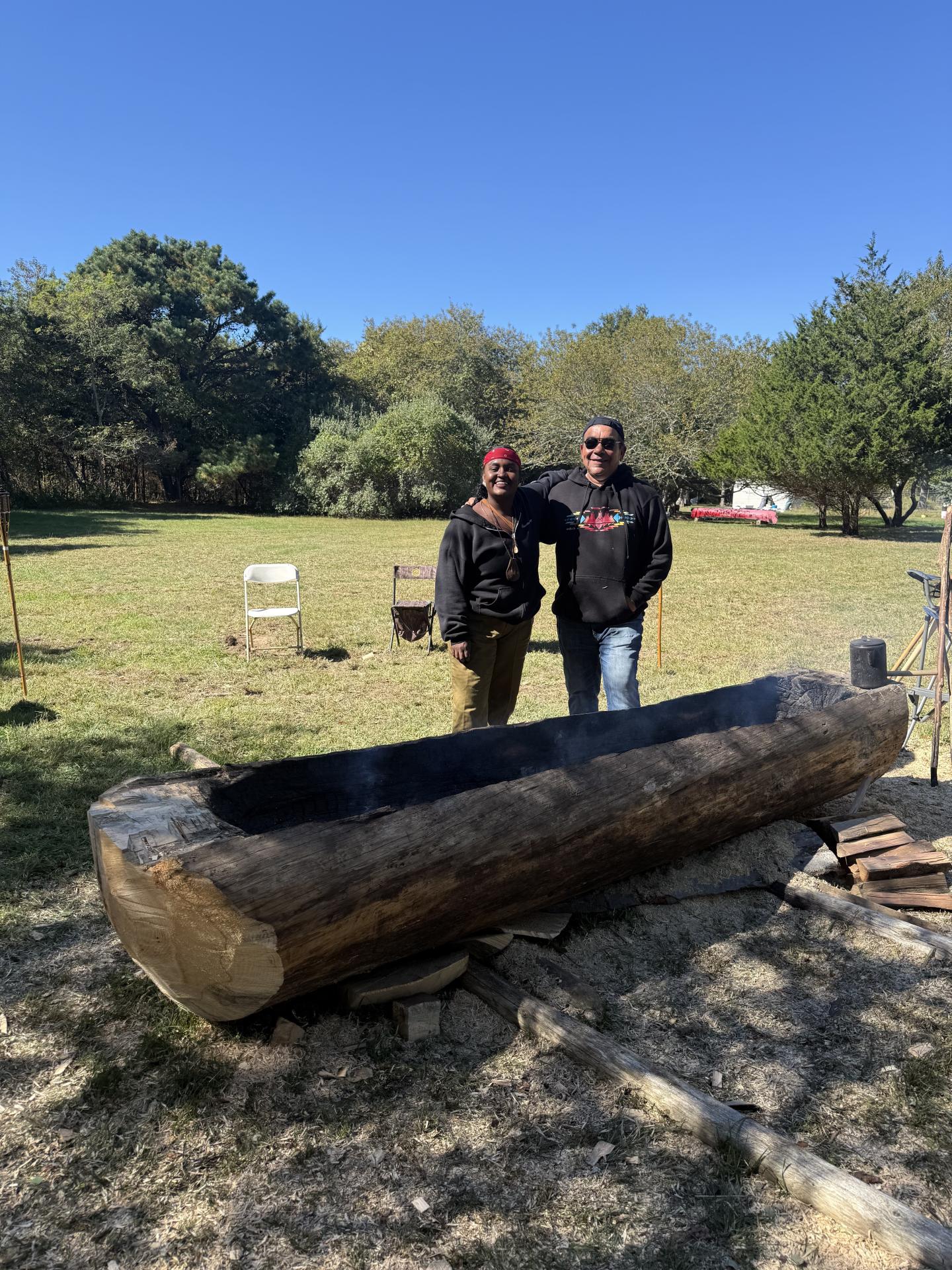
Chenae Bullock and Darius Coombs working on a mishoon. Shane Weeks working on the mini-mishoon burn.
Chenae Bullock (Shinnecock) is an enrolled Shinnecock Indian Nation Tribal member and descendant of the Montauk Tribe in Long Island, New York. She is a community leader, water protector, cultural preservationist, Indigenous perspective historian, and humanitarian. She is also the founder and CEO of Moskehtu Consulting, LLC.
Top photo: Shane Weeks and Chenae Bullock paddling the maiden voyage of Peweas Koowa (“Little Pine”). Photo by Rebekah Wise.
All photos courtesy of Chenae Bullock.