"The best journeys in life are those that answer questions you never thought to ask." - Rich Ridgeway, American mountaineer and environmentalist
Nothing about us without us
"The best journeys in life are those that answer questions you never thought to ask." - Rich Ridgeway, American mountaineer and environmentalist
Nothing about us without us
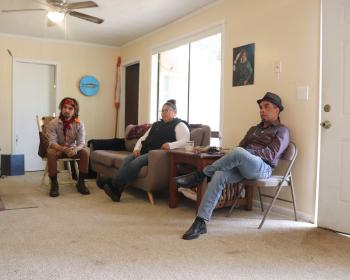
We are a radio group composed of Mapuche Lafkenche from Budi, Chile, an ancestral territory located in the ninth region of the Araucanía, a Wallmapu (traditional territory of the Mapuche people). We are Indigenous farmers and subsist on raising small-scale livestock. We are adult speakers of the Mapuche language. We are an autonomous media, self-financed mainly by the communities we serve. We are in charge of providing information, cultural activities, and above all, addressing conflicts that affect the territory.

According to the Biological Assessment and Ecosystem Services Report, conducted by UNESCO in 2019, "the main global drivers of biodiversity loss are climate change, invasive species, overexploitation of natural resources, pollution and urbanization."
This is a reflection on the shared history between Na Ñuu Savi (Peoples of the Region of the Rain) and Chumash since the origin of their respective homelands in what are now Mexico and the United States. Santa Maria is an agricultural city located in northern Santa Barbara County on the Central Coast of California. It is the second home of Na Ñuu Savi migrants from Yucha Nchaa (Santa Cruz Mixtepec) in the municipality of Ñuu Xnuviko (San Juan Mixtepec), Oaxaca.
Between the Santa Marian earth and sky is a backstrap loom on which the history of people in this space is woven. The first shapes formed on this loom are Chumash, people who came from islands and established varying groups on the now Californian coast.
For 51 years, Cultural Survival has partnered with Indigenous communities to advance Indigenous Peoples' rights and cultures worldwide. We envision a future that respects and honors Indigenous Peoples' inherent rights and dynamic cultures, deeply and richly interwoven in lands, languages, spiritual traditions, and artistic expression and rooted in self-determination and self-governance.
In 2022, The Zienzele Foundation identified the need for a communal space in the Chiware region of Zimbabwe for Shona women’s cooperatives to host their organizational meetings, health clinics, and marketing of traditional handicraft work. In collaboration with Cultural Survival’s Keepers of the Earth Fund, they have since built a community center complex near the village of Mupagamuri to serve the five surrounding villages.
Black History Month begins in the United States. Like Native American Heritage Month (November), Oaxacan Heritage Month (July/August), and Indigenous Peoples’ Day (October), I celebrate the awareness those months and that day bring about Black and Indigenous Peoples and histories, the steps it has taken for our respective and intersecting histories to be recognized by the same nation that inflicts its violence on us.
“Developing Stories: Native Photographers in the Field,” featuring essays and images of Native American photographers, is on exhibit at the New York City branch of the National Museum of the American Indian until March 12, 2023 and features the work of photojournalists Donovan Quintero (Navajo), Tailyr Irvine (Salish and Kootenai), and Russel Albert Daniels (Dine’ descent and Ho-Chunk descent).
“Developing Stories: Native Photographers in the Field,” featuring essays and images of Native American photographers, is on exhibit at the New York City branch of the National Museum of the American Indian through March 12, 2023, and features the work of photojournalists Donovan Quintero (Navajo), Tailyr Irvine